High School Science

High School Science

Observe Closely. Question Deeply. Discover With Purpose.

Students build scientific knowledge through observation, inquiry, experimentation, data analysis and clear communication.

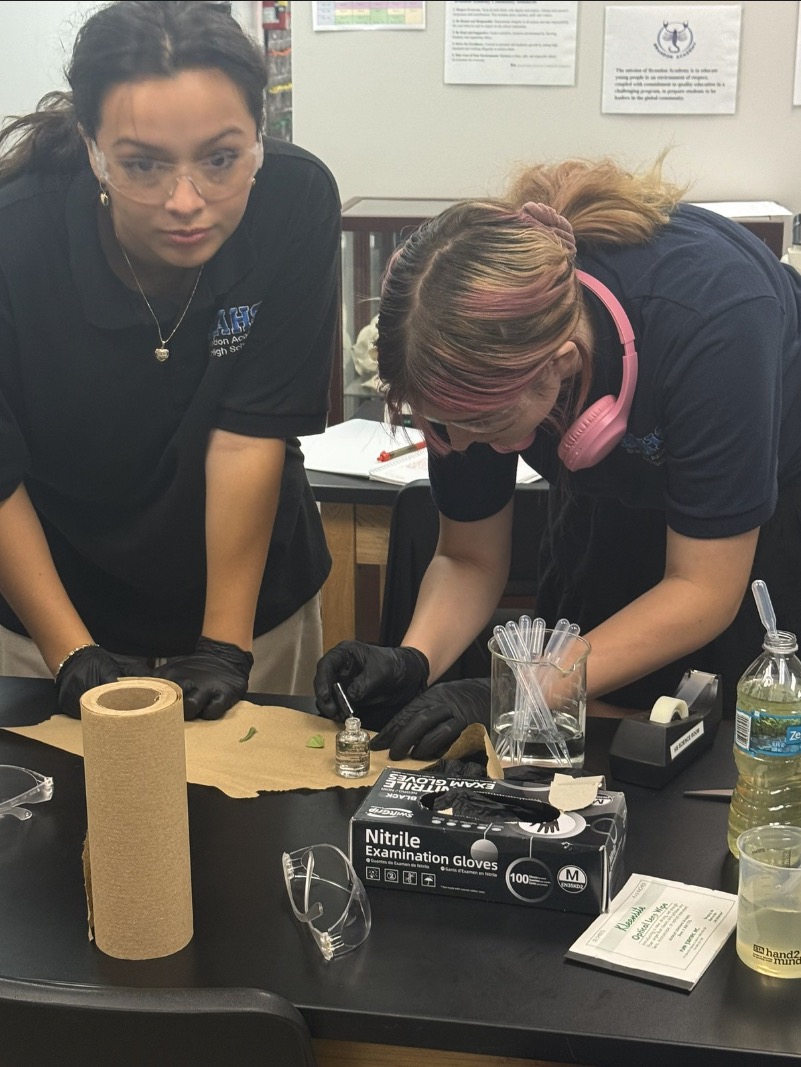
We believe science is best understood by doing it. Our students ask questions, test ideas, analyze evidence and learn to explain not only what they discovered, but how they arrived there.

How Students Engage With Science

Scientific Inquiry

Ask questions, test ideas and refine explanations.

Hands-On Investigation

Conduct experiments and develop laboratory skills.

Data and Evidence

Analyze results through qualitative and quantitative reasoning.

Clear Communication

Present methods, findings and conclusions accurately.
High School Science

Science Through Investigation

Students test hypotheses, design investigations, conduct experiments, collect and analyze data, and solve problems using both qualitative and quantitative reasoning.

Hands-on investigation helps students connect scientific concepts to the natural world, technology and everyday life. Just as importantly, students learn to communicate their methods, evidence and conclusions clearly.
High School Science Courses

Physics Honors

Students explore motion, forces, energy, waves, electricity and the mathematical principles behind physical phenomena.

Laboratory activities and problem-solving exercises help students develop scientific reasoning, investigative skills and connections between physical theories, technology and real-world situations.

Biology Honors

Students investigate life and living systems at molecular, cellular, organismal and environmental levels.

Topics may include biochemistry, cell structure and function, genetics, evolution, microorganisms, plants, animals and their relationships within the environment.

Chemistry Honors

Students study fundamental chemical principles through mathematical reasoning and laboratory investigation.

Qualitative and quantitative analysis helps students develop laboratory technique, precision, critical thinking and problem-solving skills.

AP Environmental Science

Students examine the scientific principles, concepts and methodologies needed to understand relationships within the natural world.

The course addresses natural and human-created environmental challenges, associated risks and the scientific analysis of environmental challenges and potential responses.

College-Level Options

Dual Enrollment Science

Eligibility may depend on GPA, standardized-test scores, course availability and requirements established by the college or university.

Hillsborough College

University of South Florida

Faculty

Meet the Science Faculty

Carolyn Moffett

Upper School Science Teacher

Bonnie Lehne

Upper School Science Teacher

Explore Science at Brandon Academy

Discover a program where questions lead to investigation, evidence and understanding.